Tides and Water Levels
Types and Causes of Tidal Cycles –
Diurnal, Semidiurnal, Mixed Semidiurnal; Continental Interference
If the Earth were a perfect sphere without large continents, all areas on the planet would experience two equally proportioned high and low tides every lunar day. The large continents on the planet, however, block the westward passage of the tidal bulges as the Earth rotates. Unable to move freely around the globe, these tides establish complex patterns within each ocean basin that often differ greatly from tidal patterns of adjacent ocean basins or other regions of the same ocean basin (Sumich, J.L., 1996).
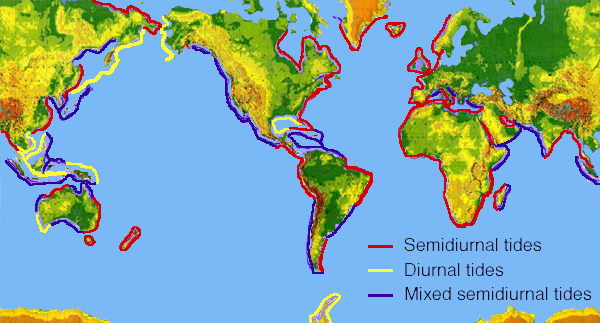
Three basic tidal patterns occur along the Earth’s major shorelines. In general, most areas have two high tides and two low tides each day. When the two highs and the two lows are about the same height, the pattern is called a semi-daily or semidiurnal tide. If the high and low tides differ in height, the pattern is called a mixed semidiurnal tide.
Some areas, such as the Gulf of Mexico, have only one high and one low tide each day. This is called a diurnal tide. The U.S. West Coast tends to have mixed semidiurnal tides, whereas a semidiurnal pattern is more typical of the East Coast (Sumich, J.L., 1996; Thurman, H.V., 1994; Ross, D.A., 1995).
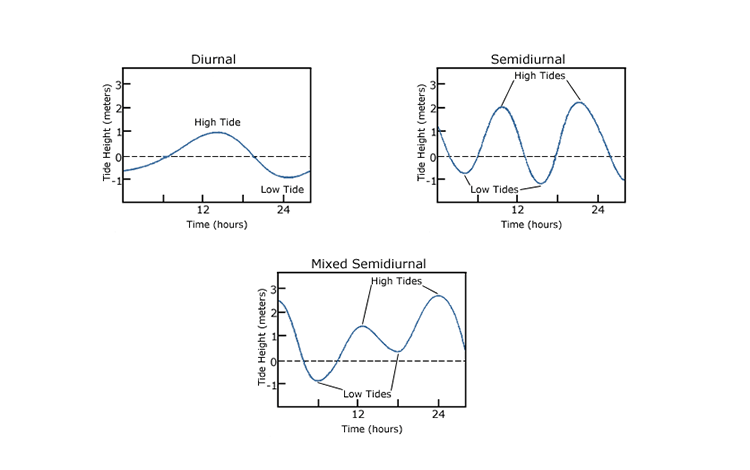
Diurnal tide cycle (upper left). An area has a diurnal tidal cycle if it experiences one high and one low tide every lunar day. Many areas in the Gulf of Mexico experience these types of tides.
Semidiurnal tide cycle (upper right). An area has a semidiurnal tidal cycle if it experiences two high and two low tides of approximately equal size every lunar day. Many areas on the eastern coast of North America experience these tidal cycles.
Mixed Semidiurnal tide cycle (lower middle). An area has a mixed semidiurnal tidal cycle if it experiences two high and two low tides of different size every lunar day. Many areas on the western coast of North America experience these tidal cycles.
Diurnal tide cycle (upper left). An area has a diurnal tidal cycle if it experiences one high and one low tide every lunar day. Many areas in the Gulf of Mexico experience these types of tides.
Semidiurnal tide cycle (upper right). An area has a semidiurnal tidal cycle if it experiences two high and two low tides of approximately equal size every lunar day. Many areas on the eastern coast of North America experience these tidal cycles.
Mixed Semidiurnal tide cycle (lower middle). An area has a mixed semidiurnal tidal cycle if it experiences two high and two low tides of different size every lunar day. Many areas on the western coast of North America experience these tidal cycles.
Tides and Water Levels