What is the EEZ?
The exclusive economic zone is the zone where the U.S. and other coastal nations have jurisdiction over natural resources
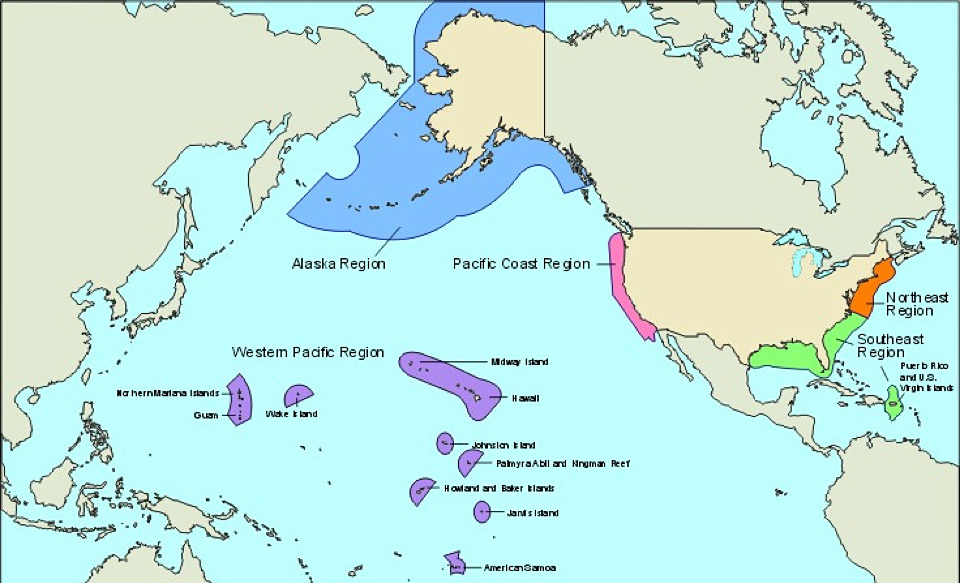
This NOAA map shows the U.S. exclusive economic zone.
The U.S. Exclusive Economic Zone (EEZ) extends no more than 200 nautical miles from the territorial sea baseline and is adjacent to the 12 nautical mile territorial sea of the U.S., including the Commonwealth of Puerto Rico, Guam, American Samoa, the U.S. Virgin Islands, the Commonwealth of the Northern Mariana Islands, and any other territory or possession over which the United States exercises sovereignty.
Within the EEZ, the U.S. has:
- Sovereign rights for the purpose of exploring, exploiting, conserving and managing natural resources, whether living and nonliving, of the seabed and subsoil and the superjacent waters and with regard to other activities for the economic exploitation and exploration of the zone, such as the production of energy from the water, currents and winds;
- Jurisdiction as provided for in international and domestic laws with regard to the establishment and use of artificial islands, installations, and structures, marine scientific research, and the protection and preservation of the marine environment; and
- Other rights and duties provided for under international and domestic laws.
Note: Under certain U.S. fisheries laws, such as the Magnuson-Stevens Fishery Conservation and Management Act, the term "exclusive economic zone" is defined as having an inner boundary that is coterminous with the seaward (or outer) boundary of each of the coastal states. While its outer limit is the same as the EEZ on NOAA charts, its inner limit is coterminous with the coastal states' boundary at 3 nautical miles, except for Texas, western Florida, and Puerto Rico, which claim a 9 nautical mile belt.
Search Our Facts
Get Social
More Information
Last updated: 06/16/24
Author: NOAA
How to cite this article