How Do Corals Reproduce?
Corals Tutorial
Corals can reproduce asexually and sexually. In asexual reproduction, new clonal polyps bud off from parent polyps to expand or begin new colonies. This occurs when the parent polyp reaches a certain size and divides. This process continues throughout the animal’s life.
About three-quarters of all stony corals produce male and/or female gametes. Most of these species are broadcast spawners, releasing massive numbers of eggs and sperm into the water to distribute their offspring over a broad geographic area. The eggs and sperm join to form free-floating, or planktonic, larvae called planulae. Large numbers of planulae are produced to compensate for the many hazards, such as predators, that they encounter as they are carried by water currents. The time between planulae formation and settlement is a period of exceptionally high mortality among corals.
Along many reefs, spawning occurs as a mass synchronized event, when all the coral species in an area release their eggs and sperm at about the same time. The timing of a broadcast spawning event is very important because males and female corals cannot move into reproductive contact with each other. Colonies may be separated by wide distances, so this release must be both precisely and broadly timed, and usually occurs in response to multiple environmental cues.
The long-term control of spawning may be related to temperature, day length and/or rate of temperature change (either increasing or decreasing). The short-term (getting ready to spawn) control is usually based on lunar cues, or cues from the moon. The final release, or spawn, is usually based on the time of sunset.
Planulae swim upward toward the light (exhibiting positive phototaxis), entering the surface waters and being transported by the current. After floating at the surface, the planulae swim back down to the bottom, where, if conditions are favorable, they will settle. Once the planulae settle, they metamorphose into polyps and form colonies that increase in size. In most species, the larvae settle within two days, although some will swim for up to three weeks, and in one known instance, two months.
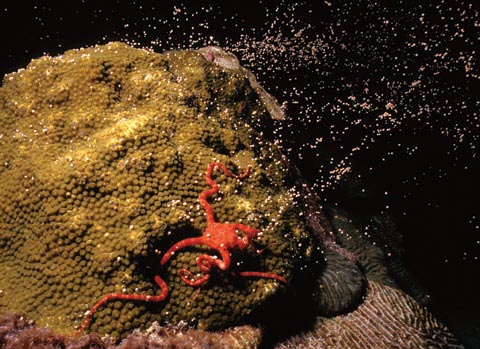
Many species of stony coral spawn in mass synchronized events, releasing millions of eggs and sperm into the water at the same time. Learn more and view a larger image.
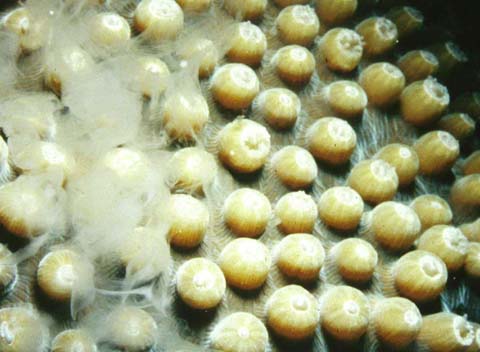
Here, a coral releases sperm into the water. Learn more and view a larger image.
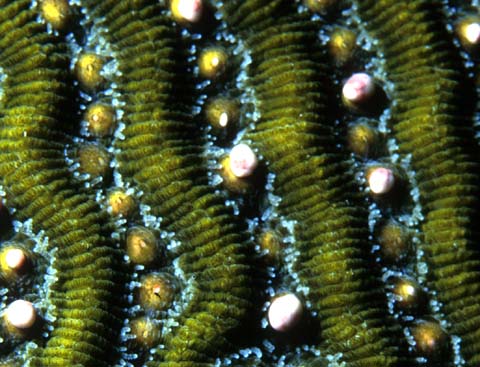
This close-up photo shows rows of individual brain coral polyps in different stages of releasing their eggs. Learn more and view a larger image.
Corals Lessons
- Welcome
- What are Corals?
- Zooxanthellae What's That?
- How Do Stony Corals Grow?
- How Do Coral Reefs Form?
- Where Are Coral Reefs Found?
- How Do Corals Reproduce?
- Importance of Coral Reefs
- Natural Threats to Coral Reefs
- Anthropogenic Threats to Corals
- Coral Diseases
- Protecting Coral Reefs
- References
- Roadmap to Resources
- Subject Review (PDF)